Der Weltenwandler
Emmanuel Witzthum
“I think the more time we spend considering the ways in which our lives are absolutely interwoven with the non - human, the more it settles us back into our rightful place in the world in terms of not this pinnacle on some evolutionary hierarchy, but rather just one more node of biological creativity.”


Martina Taubenberger
Seit Anfang 2011 begleitet Martina Taubenberger als selbstständige Kuratorin, Konzeptentwicklerin und Künstlerische Leiterin Projekte in ganz Deutschland und im europäischen Ausland. Im „Blended Art Podcast“ präsentiert Martina Taubenberger Künstler:innen und Projekte, die den Kunstbegriff repräsentieren und reflektiert aus dem Blickwinkel der „blended art“ in unterschiedlichen Formaten über Begrifflichkeiten aus Kunst, Kultur und Gesellschaft.
Emmanuel Witthum
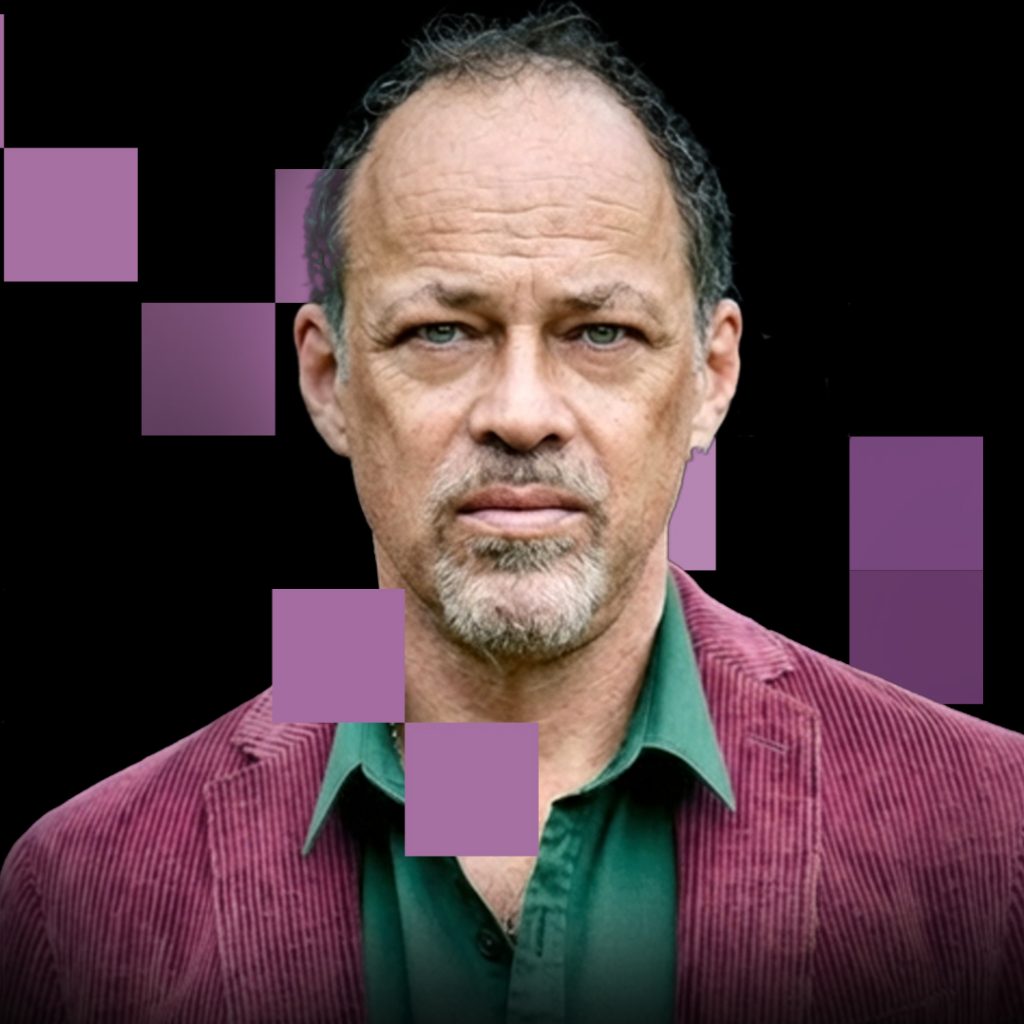
Emmanuel Witthum ist ein israelischer Komponist, Musiker, digitaler Künstler und Entrepreneur. Er ist Leiter der Kreativentwicklung des Kulturzentrums Jerusalem Season of Culture und Artist in Residence bei Zeiss. Emmanuel bewegt sich zwischen allen Welten und hat keinerlei Berührungsängste, neue Formen, Formate und Ausdruckssprachen auszutesten. Er ist gleichzeitig Künstler, Erfinder, Führungspersönlichkeit, Berater, Impulsgeber und einer der Künstler, die wie vielleicht wie kaum jemand anderer den Begriff der „blended art“ verkörpern. Er ist für mich in den letzten Jahren zu einer Art „künstlerischem Soulmate“ geworden, Emmanuel übernahm gemeinsam mit mir die künstlerische Leitung des Festivals Out Of The Box 2025.
Martina Taubenberger: Blended art is my concept of a hybrid art that does not need genres to define itself. My name is Martina Taubenberger and in the Blended Art Space I’m talking to artists who embody that concept for me.
MT: Hello and welcome everybody to the first issue of my podcast, Blended Artspace. This podcast is actually meant to let you in a little bit on the conversations I usually have with artists after the performances – when we sit together over a glass of wine in my apartment. And I am talking to artists that represent my concept of blended art – that is an art that does not use disciplines or does not need genres and disciplines to identify or to define itself.
And today this artist, the first artist, is Emmanuel Witzthum. And we’re actually sitting here over a glass of wine, and we can actually prove it. Let’s prove it.
Emmanuel Witzthum: We’re here over a glass of wine. Cheers.
MT: And it’s a Vino Nobile di Montepulciano. So let’s see what this brings about.
So this podcast – you usually think about how to start. What is the first question? And since all the artists that I’m going to introduce to you in the next couple of months, maybe years, have something to do with my professional life, the first question is: how come we know each other? How did we actually get to know each other? And I’d like to hear your story and not mine.
EW: First of all, hello Martina. It’s a pleasure to be here. It’s a pleasure to be with you.
Second thing is – we met through a common friend and colleague. I met Abhay, who is a cultural entrepreneur and consultant, at a conference in Mannheim. I gave a presentation at this conference and after the presentation we sat together in a panel around audience building in the digital age, and we very quickly became very good friends. And following our time together in Mannheim, Abhay incredibly generously decided that he wanted to connect me with people that he loved, people that he thought were doing great things. And he set up a number of Zoom calls with such people.
MT: Oh really? I wasn’t the only one?
EW: No, I’m sorry. You weren’t.
MT: Yes.
EW: But you were one of the special ones.
MT: I see, I see.
EW: And I’ll never forget this – that very quickly, as we began the conversation, it felt like you and I were alone on the Zoom call.
MT: You know what, I think Abhay felt the same way, because he reacted kind of hurt at some point.
EW: Oh no.
MT: I’m still here.
EW: But he was also very generous and really let us flow with our conversation. We very quickly – I felt – had a very strong connection. And it was so strong that within a few weeks we’d begun to work on a project together. A project that I’ve been doing for a number of years: I come from Israel, I live in a kibbutz outside Jerusalem, and I’m one of the artistic directors of a cultural center that attempts to dissolve boundaries between people through art. For this center – that used to be a festival once, that’s a complex story but we can get back to that later – I created a project where we used field recordings of the city of Jerusalem and transformed these field recordings into an audio-visual immersive experience.
And you, I remember – you were looking at me and I was looking at you, and all of a sudden I saw that your brain kicked into seventh gear. (laughs)
MT: That’s how we met.
EW: Yes, that is true. That’s a very good way to describe it.
MT: I also obviously remember the story, and there’s another very funny story about Abhay and me that I’m not going to tell now because then this is going to take two hours. But for some reason I could not refuse when he said, „Listen, I want you to meet this guy Emmanuel Wittstum. We have to set up a Zoom conference.“ And before I even could think about who is this guy, what am I supposed to do with him – he had already suggested a Zoom date and had already sent the link. And I was like, okay, I don’t know why, but okay, let’s talk. So I had no expectations. And I think I didn’t even have time to Google you before, because it was so fast – that’s how Abhay works.
And I also remember that right away, I think we were talking about five projects in that first Zoom meeting. And I felt like I’m going to do the rest of my project life with Emmanuel. So this is really amazing. This was like love at first sight.
EW: It really was.
MT: Yeah. Maybe we talk a little bit about Dissolving Localities later. I just would like to go back to the question of who and what you actually are. You mentioned it already in parts, but when you look at your website, I think it’s always interesting to read what people put on top of their biographies. And I find it interesting because I never know what to put there, because no term really fits with blended artists like you. So you say: musician, digital artist, artistic director, and cultural entrepreneur. Now two things strike me. The first thing is – I find it very interesting that you put musician first. So the question is, is there any reason for this very order of terms? And the second thing that strikes me is that it doesn’t say composer, although you really appear to be a composer – like in almost every aspect of what you do, you kind of also are a composer.
EW: I think it really is very difficult for me to define who I am – to the degree that when Alma, my oldest daughter, went to seventh grade and I think they had a thing where all the kids said what their parents do… (laughs)
MT: Oh, poor kid.
EW: Yeah, and she actually called me and said, „Dad, what do you do?“ That’s actually the call my parents could do to me – „Daughter, what do you actually do?“ Because it really is very difficult for me to define what it is that I do. I mean, I work in the cultural sector. I’m an artist, an artistic director. I find it very difficult for me to define myself within this spectrum of being an artist. I do digital projects. I’m a musician. I compose. But when I compose, I don’t feel that I can identify very strongly with situations where I’m asked to compose a piece of music. I can identify more with a situation where I’m invited, or I am allowed to create a world, or when I’m allowed to imagine a journey. So the process of my composition is not putting notes on a piece of paper, rather imagining the potentiality of what music can do once it’s expressed with a group of people.
And as a result of that, in all of my work, there is a very – I would say – profound battle: trying to, on the one hand, define, and on the other hand, to unravel. And I’m very comfortable being in this place, and it’s impossible for me not to. And yet, on the other hand, there is a voice in me that says, „Okay, but so what do you do? What is it? What do you know?“ And it really is very difficult for me to define that.
MT: But I really love that you say that – because just for the audience out there who doesn’t know why we are sitting together over a glass of wine: I invited Emmanuel to be one of the composers for the festival Out of the Box 2024, that we’re already starting to prepare. And just as you described this – I invited you as a composer – and sitting here over the last three days in a lot of conversations that not necessarily only evolved around the festival, we started a journey and now it became more about creating a world. So this is maybe a bit of a mysterious spoiler to the 2024 festival, but it’s going to be much more than just a commissioned piece or a composition. It’s really going to be a very intense collaboration where we’re going to bring other people in and try to rework the whole festival format.
So what you just described is something that I can totally relate to in reference to the conversations we had in the last couple of days. I hope that makes sense to people outside our little wine circle in here.
EW: That is a very beautiful way to put it, I think. I mean, it’s so easy to categorize someone as saying, „Okay, well, Emmanuel was a professional viola player, and then he studied composition, and he studied in New York, and then he lived in Paris and worked at IRCAM, and then he moved to Berlin, was a guest of the DAAD Künstlerprogramm and played with the Staatskapelle, and then went back to Israel and played with the Israel Philharmonic and did all these things.“ But these things don’t represent who I am. They represent things that I did.
And when I think about who I am, I’m much more curious about what these experiences as a musician are overall. These encounters of different cultures, the processes of how philosophy and music interact with one another, to really ask serious questions and then figure out ways in which they can express themselves that can communicate to audiences – these are the worlds that I’m very, very curious about being in.
MT: That was a very nice, concise summary of your biography, by the way.
EW: was trying to ground it for a second.
MT: Yes, very good. I mean, one of the questions I want to ask my interview partners – or my encounters, as I call them – is: how did you actually get in touch with the arts, or how did you become an artist? I know you already mentioned you started off as a viola player and a composer, you studied composition. So I’m going to ask the question in a little bit of a different way. What were the influences on this journey that you just described? What were the most influential parts that actually made you this hybrid artist that you are today? Because you could just as easily have gone with – it sounds like a kind of mainstream biography for a composer. So what was different from other composers‘ journeys that made you the artist that you are?
EW: I think that for me – this is also unfortunate – every time I got somewhere, I immediately wanted to leave. So instead of building on something that I’d managed to reach, I wanted to do something else.
MT: How come?
EW: This was just how I’m built. I was in New York, studying with Michael Trier of the Guarneri Quartet, I was invited to be part of the Orpheus Chamber Orchestra. And then the logical step would have been: okay, so I’ll stay in New York, I’ll get into the freelance scene of viola players, maybe play at the Met, maybe at the New York Phil as a substitute. My decision was to move to Paris – where I did speak French – to work at IRCAM, even though I didn’t know how to turn on a computer, and to leave New York and move to France.
This is a representation of many choices that I’ve made as a person and as a musician. I’m very unhappy with the idea of doing the same thing again and again. At the same time, I’m very happy to put myself at risk – to do things that I’ve never done before, to explore things that I really don’t know. And I’m very comfortable not knowing. And I also love the idea of being in a situation where something concrete is thrown at me, but it’s my approach that will make that concrete thing my own.
This represents a lot of the projects I’ve been involved in, a lot of the centers that I’ve been artistic director in, and a lot of my approaches as a musician, as an artist, as a creative person. And also the fact that my music is very eclectic. If people go on my Spotify, the music there is mainly neo-romantic, classic stuff. I also have very experimental electronic music. I have a really wide range of music, and I’m very happy living on that liminal space of creativity.
MT: But now – how long have you been back in Israel?
EW: So I came back in 2005 or 2006.
MT: Yeah, because this is something – I mean, it’s maybe a bit of a personal question – but you mentioned family. I think this idea of, as soon as you are in a certain place you try to leave it again, doesn’t work immediately when you have family. I say this as a mother of two myself. And how did this change that journey of yours? Or do you find other ways to get into that development mode, that challenging-yourself mode that you’ve had your whole life?
EW: So when I returned to Israel, I was in a situation where I decided that I was going to stop being a composer. I reached an impasse in my musical path and I felt that I needed a break. So the return to Israel was a very strong cut from the progression that I was in.
Having said that, ever since I returned to Israel, new paths have unfolded and I still work very internationally. So even though I have family and two daughters and we have built a home in Israel, I would say 50% of my work is abroad – mainly in Europe and the United States. And my collaborations have diversified. I’ve worked very recently with the Alvin Ailey Dance Company and –
MT: Oh, really?
EW: Yeah, and I’ve recently been involved at the ETSAIS Innovation Hub as a creative resident. And I’m currently working on a project for Ensemble Moderne. There are many, many ways that things have emerged, but they were never part of a strategy as a musician.
On the other hand, my work in Israel has found a way where I’m balancing my work as artistic director together with things I’m trying to work on in order to dissolve boundaries between people, or work in an organization that is actually trying to create change in Israel. I’m working as one of the artistic directors in a very unique cultural organization that has a blend of almost 50% Palestinians and 50% Israelis. We also have ultra-Orthodox Jews in our teams. It’s a very challenging and very inspirational group of people to work with.
My path has been: on the one hand, I do my musical or creative projects and they are very, very diverse in where they are around the world and in their fields. And in Israel, there is in a way an opposite side – going down into an even more profound direction.
MT: Yeah, that was very much kind of a typical answer that I get from you when we discuss things. Like, there are for me about a thousand questions that I could derive from what you were just talking about. Because whenever you talk to me about projects or about things that you did, it all feels like – oh my God, what is all this? And just as you said before, you’re doing so many different things, and I always have the feeling that in each project you describe to me, it is a world in itself.
And yeah – well, as I said, I have many, many questions about this, but maybe you can go back to what the Jerusalem Season of Culture is and what you’re actually doing there? Can you give us a couple of examples of projects?
EW: Sure. So the Jerusalem Season of Culture was created 12 years ago. The idea – it was a festival – was to create a framework to commission original works of art in a way that I wouldn’t even say is multidisciplinary. It’s even transdisciplinary. So it could be anything –
MT: Blended art.
EW: Yeah, exactly. But all of it related to Jerusalem. So Jerusalem was the source of the creativity, or unique locations in Jerusalem. We had projects that took place in caves, in parks, even in a swimming pool, in people’s homes, on rooftops, et cetera.
And three years ago – after I’d been involved there as an artist for numerous projects over the first nine years – in 2019, they approached me to be artistic director of a project. It was going to be the biggest project they’d ever done. The original idea came from Philadelphia, where the Philadelphia Center for Contemporary Art created an orchestra that played music on broken musical instruments.
Now, we really liked this idea. We said, „Actually, this potentially has a very interesting perspective on telling the story of Jerusalem.“ Telling the story of a city through broken musical instruments was a storytelling platform we found very, very interesting – sort of like a meta-narrative.
But when they commissioned me to be artistic director, we very quickly understood that we couldn’t work in the same way as Philadelphia. There was one composer, it was a very experimental project, I think there were like 200 people in the orchestra and like 100 people in the audience. It was a very unique –
MT: And it’s all amateur musicians?
EW: Some amateurs, some professional. It was a very beautiful idea, but we needed to make our own vision of it. They had collected musical instruments from conservatories, and professional musicians came and performed on those instruments. We wanted to change this and say: we want to invite people to bring their instruments. We also went to conservatories and warehouses.
MT: That was your contribution already to the concept.
EW: Oh, I’m sorry – now I spoiled it!
MT: No, no, it’s fine.
EW: But most importantly, we understood that in order for this to be a project that anyone could feel welcome in – both musicians and audience – we needed the project to speak a different language. So we set about creating an orchestra. In the end, we had 115 musicians, from the ages of eight all the way up to 80. We had Palestinians, we had Israelis, we had people who played North African or Middle Eastern instruments, Western instruments. We had people playing on broken intercoms or doing really bizarre musical interpretations of what their instrument could potentially do.
And this is the only way to do it, because some of the instruments really couldn’t do anything. There was a trumpet where all the buttons didn’t go up – so you can only play one note and pray that at some point it’ll actually go up so you can play another.
MT: So there needed to be a lot of rests in that person’s part. Or that person could just breathe a lot.
EW: There were instruments where you had a guitar without a neck, a violin where the back was broken. You really had to first map out what these instruments could do, then try to match that to the musicians who were playing, and then tell the composers what they could write – because it’s not like a classical orchestra where you know the sections and you know the musicians will play what you write. Some of these musicians were very amateur and could play very limited music. Some of these instruments couldn’t do anything other than sound like an elephant stampeding. We needed to create everything from scratch – and together with telling the story of Jerusalem.
MT: So that is amazing. You basically turned the whole process around. When composers take instruments, they make the musicians discover their instruments in a totally different way – by telling them: you’re not only playing it in the conventional way, you’re using this noise, that noise, that way of playing. So you had to really engage with each individual player and each individual instrument.
EW: Yeah. So it was not the musicians having to study the score – it was the composers having to study the instruments before they could even write the score.
MT: Yes! And then the musicians needing to figure out what their instruments can do, or what they can do with their instruments. So were those one-on-one sessions where you would map the instruments together with the players?
EW: Yes.
MT: This is a huge process.
EW: Yeah, the project was almost a year in the making. It was gargantuan. Really, really huge.
And one of the things that was very important for us: as everyone knows, I think Jerusalem is a very tense place, and a wondrous place as well. But almost any decision you make can become controversial. One of the difficult things was where to have the concert. If it’s in a hall, maybe someone would have a problem with that hall. If it’s outside, where is it geographically – some people might have a problem with that. At the same time, some of the people who were playing had never been to a classical music concert or a concert in general. We didn’t want them to feel alienated – like, „I don’t belong here, this was a mistake.“
So we spent a lot of time imagining their journey to the concert: where can this be? In the end we decided on a place on the seam between the Old City and the Cinematheque in Jerusalem – a place where everyone could feel comfortable. The conductor was in the middle, the orchestra in 360 degrees around the conductor, and the audience in 360 degrees around the orchestra. There was no separation. No frontal situation. Everyone was part of it.
And the concert began by everyone singing together a note. From this note, the audience and the orchestra singing together, the orchestra began to play – and then gradually the broken instruments began to sound. It was a really lovely, organic feeling to what we were doing.
At the same time, I said to the team: no one will be able to understand what we’ve done simply by coming to the concert. We need to have an additional layer that is hidden during the process and comes alive when the process is finished. And we can do that through a documentary film. So from the beginning there was a documentary filmmaker shadowing us, and in the end, after the concert, they went into post-production. The film was released this year. It was presented at a number of documentary film festivals and is still touring.
And it was amazing, because it’s become another part of the project that is part of the project and yet independent of it.
MT: Of course. And that’s lovely, because it’s not only an amplification, it’s not only a postscript. It’s actually now a living thing that has taken your process and transformed it into something else.
EW: And that’s something that I’m very, very happy about.
MT: Can you access that film anywhere?
EW: It’s now doing a tour of different documentary film festivals. I hope that it will be open to be viewed digitally or in other formats after that. But I did that, and then a year later – right when Corona hit – I was asked by the Jerusalem Institute of Culture to join the team in a more permanent basis. My role there is on the one hand to support projects as they begin, either consulting them or guiding them in their early stages. And at the same time, I’m also artistic director of a platform that we’re developing – a mobile platform for site-specific digital work.
The idea came mainly because of Corona, where we wanted to develop a sustainable arts platform that did not require, every single time you wanted to present a piece of work, all the logistical production, hardware, ticket sales, and audience situation. Rather, from the moment we created it, it could be accessed at any time by anyone who wanted to experience it. That’s one aspect.
The second thing was social distancing – we couldn’t bring people together, so we wanted people to be able to access art without fearing being too close to others, without lockdowns imposed.
And the third thing was: I was very interested in whether we could create an equal relationship between an artistic work, a location and its context, technology, and the audience. All of the work we’re developing in this platform investigates all of these parameters together.
It takes place on a promenade outside our center, on the seam line between East and West Jerusalem. And we don’t use this promenade as a stage. The artistic experience relates to the place. Sometimes it can only happen at a specific time or situation during the day – or maybe it only happens when it rains. And this was very important for me: can art express itself in dialogue with processes that are already in place?
This is a project I’m developing right now, and it’s been a very inspirational journey because we’re learning so much from it.
MT: How important is it for you that these projects can be transported elsewhere? When I listen to you – and we’ve talked about both projects in the past – I immediately think: I want that. I want that for Munich. And I think it is possible to adjust it to another context or situation. But how important is that? Because I often have the feeling there are so many innovative ideas out there and so many artists doing amazing stuff, but it usually stays in one place. This transfer is not really taking place, not enough.
EW: All of my projects have the potential of scalability in mind from the outset. That’s something absolutely very, very, very important for me. Dissolving Localities – the project that I created in 2009, where the idea was to remix the daily life of Jerusalem – almost half a year after we launched it the first time, it was invited to perform in Paris. And I said, „Well, okay – why don’t we do it in Paris and combine Jerusalem and Paris?“ It wasn’t possible production-wise, but we suddenly realized: actually we can remix any city. We can connect Jerusalem with any city. So we found ourselves with this project in Japan, in the States, in Europe, and it’s flowered into many, many different types of experiences – from installations to live performances.
Another project I’ve done is called Mix the City. It’s a digital web platform that allows people to make a mix of local musicians in a city, on location, and by making that mix – by playing and recording the musicians – they make a video. The idea behind the platform is to discover a culture by making music. So if your usual experience of discovering a culture is by reading about it, by going there, by seeing photographs, we thought: why don’t we try to create a situation where you discover a culture by making music?
We did this first in Tel Aviv. In the end, three years ago, we did it in 22 other cities around the world.
MT: You personally have done it in 22 cities? How do you do that? Seriously – how many projects can you take on at the same time?
EW: This is actually a good example of how… So Mix the City cost X amount of money to develop, and it was an idea that I had by approaching an Israeli artist and a British development company. In order for it to scale, we needed the idea to be malleable enough that any city could take it and say, „Yeah, we can do this too“ – not, „Oh, it’s only for Jerusalem.“ And at the same time, it had to be cost-effective so that a city didn’t have to pay the same amount it cost to develop. And at the same time, it had to provide revenue for us to sustain ourselves.
Both of these things were built in from the first iteration of the project. And then my role was basically almost like business development – finding the opportunity, negotiating the contract, and then project-managing the artists, curators, and development team. So in a way, my role was much more about managing the project – almost like a puppet master – not immersing myself in the actual day-to-day creation of the music or the code.
And that’s something that I always do alongside my musical projects, where I’m much more involved as a musician.
MT: So this goes back to the blended thing. Now we understand why there’s “cultural entrepreneur” on that list! And maybe I even understand the order now – musician, digital artist, artistic director, cultural entrepreneur. It’s kind of a journey you’re describing.
Now that we’ve gotten to all those efficient business matters, I wanted to come back to something that I find rather curious: you used to work with Google and you are presently working with Zeiss. So what are you doing there?
EW: So Google and Zeiss are two very different projects.
When Google approached me to do a project with them –
MT: How did they find you?
EW: I think it was a word-of-mouth situation. They were looking for an artist, and a curator I had worked with before heard about it – they were looking for someone doing something related to the field recording project I was doing. They were about to launch Google Maps and they wanted to see whether Google Maps could be launched not as a toolkit or platform for data, but rather to take it into a creative place. They were doing this as part of an arts fair in Tel Aviv, and they launched a project called DevArt where they connected artists with developers to experiment using Google technology.
There, it was the first time I did an interactive arts experience where people on Google Maps could make journeys and paths. Once they rendered their journey, it became Dissolving Localities – their journey blended the sounds of those places together with music and hybrid video.
And afterwards, Google invited me to give talks at different centers, because at different centers they said that the work with startups or young developers faced a cultural hurdle: these people were afraid. They didn’t feel their product was ready. They didn’t feel they knew enough to launch. They didn’t feel their story was tight enough. And I spoke to them about taking risks and about not thinking about product, but thinking about story. Because in the end, when you’re a startup, no one invests in the product. They invest in the people. They invest in the vision. They invest in the potential. All investors know that a startup at its early stage may well not launch with the same product they began with – but they want the person. And the people I was talking to, the majority of them, were focused on the product.
So the things I was talking with them about was this idea of the story. Because I felt: if you have a good story, the outcome can happen. If you have a product, it can either stay where it is or get stuck.
MT: Wait a second. I’m back in that first Abhay conversation where I thought, “This is amazing.” Looking back at your biography and the journey you’ve come so far – where did you get that? Where did you get the knowledge and the confidence to actually stand up in front of people from a totally different world, who might look at you as an artist – as somebody from an alien planet? Where did you get that confidence to actually do this, and analyze it in this way?
EW: I think it all stemmed out of when I came back to Israel and began a master’s degree in cultural studies. At the same time, I was approached by the Israel Festival – Israel’s biggest performing arts festival – to consult with them around music.
MT: How old are you, anyway? It sounds like you’re 75.
EW: 89.
MT: What?
EW: I’m 46.
MT: That’s intimidating, you know that.
EW: So during my time at the Israel Festival, I was approached by a theater in Jerusalem to become their artistic director. I really liked this theater – it was a multidisciplinary theater, very small, and I liked the stuff they were doing. The first meeting I had with the CEO of the organization – this was the first time I was artistic director, so I was quite inexperienced – he said, “Just so you know, this is our budget. Our budget covers the salaries, the building, and taxes.” And I said, „Okay, and where’s the money for the artistic creations – which is why we pay the salaries and why we have this building?” And he said, “I don’t know.”
MT: (laughs)
EW: And I said, „What do you mean you don’t know? So what am I doing here?“ He said, „Well, you need to figure that out.“
I came out of that meeting very nervous. And I decided to see whether I could salvage the situation. I went into very deep thinking mode. And I said: „No one will give me money for a project. No one will give me money for a product. People will give me money for a story.“ Why? Because the story has transformational value.
And I then set out to create a story. Within one year, we had created six projects, two of them scaled. Dissolving Localities was one. And I saw basically that by understanding that stories have the capability to change perception and to change lives and also to influence reality – that’s something that stayed with me.
So when I was going to Google, I wasn’t coming as an impostor. I wasn’t saying, „I’m this great entrepreneur who’s invested millions of dollars.“ I understood the importance of stories.
MT: But this is something that a lot of people talk about. Storytelling is this big buzzword. What does it actually mean? Can you give me a concrete example of what you mean when you say you turned projects into stories?
EW: Definitely. So within our center, I was doing something that the Jerusalem Season of Culture were also doing: using Jerusalem as the basis of all artistic projects.
One such project was called Dancing Spirit, and the idea was to use prayer as the source for contemporary dance original commissions. This was in a way a blend between two worlds that collided. For the religious community, the idea of dance is very problematic. And usually contemporary dancers or choreographers are very secular. So using prayer as the source of their work is something quite different, quite remote from where they are.
By creating such a platform, we were trying to say: we have a stipend for the choreographers. Anyone who wants to participate has to come to a three-day workshop where they study the idea of prayer from a huge diversity of perspectives – religious, psychological, social, cultural, poetic. Afterwards, they submit an idea, and then we nurture them in developing their work. The end result was a series of dance performances where, for the first time in our center, religious audiences came together with secular ones.
The organizations that funded this saw that we were trying to bridge divides. We used Jerusalem in a way that said: yes, Jerusalem is incredibly diverse, incredibly challenging and intense, but it exists because these tensions interact. We were trying to figure out a way for these tensions to interact artistically. That’s one way where this vision brought us enough money to create the project.
Another project was Dissolving Localities. The idea that we’re not interpreting Jerusalem – we’re using the daily life of the city to create art. The cars, the prayers, the markets, the different streets – they become the source of our art. So the story was that the city of Jerusalem, from many different perspectives, becomes the artistic creation.
MT: Wow. Okay, so – Zeiss.
ET: Zeiss was an unbelievable opportunity. What happened was: the city of Mannheim, with whom I have a very strong relationship for the past seven years, has a program where they put artists in accelerators. The director of the Innovation Hub at Zeiss heard about this and was very interested in bringing new perspectives into their more explorative phases of research. He was looking for someone with a completely different background to bring into the team. Mannheim thought I would be an interesting person to connect with him.
We had one meeting – like you and I had with Abhay – and then a series of meetings, then a series of interviews. Following that, they invited me to come to Zeiss as a creative resident. They did not want me to come as an artist. They said, „We want you to come and bring your artistic perspective into how we work. Not to necessarily create your artistic work – this can happen in the future – but right now we want you to be with us, bring your perspective on the projects we’re working on, and see whether we can think in a different way.“
So I spent a month there in Jena, Oberkochen, and Karlsruhe, shadowing the teams, taking part in pitches, taking part in group discussions. It was an unbelievable experience.
MT: Is it being evaluated? Are there any changes or effects already?
EW: Yeah, there was an evaluation, a report, and then a discussion with the director there. Two strands are being developed. One is a continuation of my first shadowing process. The second is an evening we’re going to have at the ZKM in Karlsruhe with Ensemble Moderne and two other speakers, talking around the topic of exploration in art, science, and business. And the other strand is a continuation and deepening of the work we’ve done before.
But yeah – for me, this was the first time as an artist that my value to a discussion could be that the way of thinking that I have is valuable beyond artistic expression. And that was the first time I experienced that in a profound way – like with Zeiss.
MT: That is an absolutely exciting example of how the dialogue between the arts and a corporate company can be really, really fruitful. And I think there are rare occasions where this is actually seen like this. So this is really fascinating – something I very much like to follow.
I’m kind of looking at the clock a little bit. This went by like nothing. I think you all know why Emmanuel had to be my first guest here. It’s not just because he happened to come my way – if you would try to find a personification of the term „blended art,“ I think it would be Emmanuel. And maybe you already understand what I mean with blended art, because that’s exactly what you are.
I have one last question – and maybe it’s even the most difficult question. Is there anything… It all sounds like you’ve done so many fascinating things, but is there something that you always wanted to do that hasn’t happened yet? A project that you think: this would really interest me, maybe I can make it happen?
EW: To be honest… you know what? I’m going to be even more honest than I thought I was going to be. I think it’s not necessarily that there is a project I want to do that I haven’t done yet. Rather, I would be very happy if I could find a way to be more confident in my voice.
MT: So – you yourself?
EW: Yeah. I think that while I do a lot of projects and while I have a capacity to overcome insecurity – a sense of, I would say, lack of worth or doubt – I have that inside. And I think that if I would find a sense of peace with who I am as a creator, this would be something I would be very, very happy about. Because I find myself many times needing to overcome an inner voice as an artist – not necessarily as an artistic director, but more as an artist – that is very difficult for me to overcome.
I’ll give you an example. I was invited by the ultra-Orthodox team in our center to give a talk to Haredi women artists. And I asked them what they wanted me to speak about. They said, „We’d love to talk about failure.“ And I said, „That’s interesting – I’ve never talked about failure before. Usually we talk about success.“ And they said, „No. These women are surrounded by a sense that they’re not good enough. Secular artists, they feel, know more. They control the industry. On the other hand, there is no place for ultra-Orthodox artists – they live in this bubble, this vacuum. So they live in this insecurity. And we want you to talk about projects that failed and how you dealt with this failure.“
It was supposed to be a two-hour conversation and it ended up as four hours long. And I came out of that absolutely empty. I gave them everything. And I spoke very, very honestly. And one of the things that was important, because I’d never spoken about it before, is how the conditioning – the overwhelming power of culture and expectation and categorization – influences who we are as artists sometimes.
It’s like: I have an inner voice that wants to create certain music, and I know I can’t – because they’ll think I’m insane, or they’ll think it’s not good enough. Or I really would like to perform with this ensemble, but if I write this piece of music, maybe they won’t like it. Or I’ve got this commission: wow, maybe they’ll hate it. What will I do?
So it doesn’t necessarily mean that the final outcome – I have found a way to resolve it – but the process takes such energy. The inner battle of confronting these demons saying, „No, you can’t.“
MT: But you know what, don’t you think somehow this is part of being an artist? And maybe part of staying – staying fluid, being open. I don’t know what happens if you… I have the same thing. I don’t know how many concert talk series I really have to prepare, and I prepare contemporary music. Every single time – I’m telling you, every single time – I start preparing for a concert talk, I think: „This time I’m not getting it. This time I’m not getting there.“ Because you have this limited time to prepare the piece, you have the score, you have some material, but then you have to trust your listening and your ability to analyze the score, and at the same time find the key to bring it to the audience.
And every single time I start, I think: this time it’s not going to work. And somehow – maybe if you come to a task or to an artistic project thinking „I have it all, I have that peace and that confidence“ – maybe you are not open enough to let in influences and emotions. Don’t we need these insecurities to stay… durchlässig? Permeable? Don’t we need that?
EW: Yes, but I wasn’t talking about that. I was talking about the fact that if I would have followed the path set for me, I would still be a contemporary music composer doing certain music that I felt was expected of me. But inside me, I had different music, and I wouldn’t let it out – because I felt that it’s not the right thing to do. Because people would say it’s not good enough, or „What? You write this type of music?“ And I needed to clean all of this noise – and I’m still cleaning this noise – in order to say: you know what, I don’t care if you think it’s good or not. This is something that’s in me and I want to let it out.
And only recently – going back to the Spotify page – am I letting it out. But it needed so much work to be able to let that out. It’s like my voice saying: you know what, maybe some people will not be happy that I’m expressing myself, but actually I don’t care. Because it’s important for me not only to be accommodating, not only to say „maybe I’m going to hurt someone, so I won’t say anything,“ but: without being overwhelming and coming in good faith, I want to feel comfortable with myself and say – this is me.
So I’m not saying peace is always a battle – that’s true. But there are pieces that have never been expressed because the battle is overwhelming them. And I think that’s one of the things I would love to figure out.
MT: I see. So basically what you’re also saying is that you might have ended up doing so many different things, and so many hybrid things, because at a certain time in your biography you didn’t trust yourself as just being a composer. So you started opening up to do different things.
And I find this very interesting, because I used to study John Coltrane when I was at university. I read his biography and I was so overwhelmed by the fact that he did this one thing – he was so concentrated and focused on improving on his instrument and being this amazing jazz saxophone player that actually revolutionized jazz. And I felt like I could never be that. I could never trust myself in anything that much that I could just go for this one path. And I felt this as a huge weakness – almost like a failure – that I was so broad, that I did so many different things, and I always felt: how come I cannot focus?
And it was actually my clarinet teacher back then – it was in Chicago – who told me that she actually thought it was my greatest strength. She said: „Whatever you’re going to do in your life, you’re never going to do just one thing, and you’ll always be successful. That’s who you are.“ And maybe that’s the way to look at it. That many people who have this one focus, this one madness, and also the confidence – this inner force – they might be just as unhappy.
EW: Yeah. I think – I don’t know. But I know about myself that I’m very, very curious and I always want to do new things, to experiment and try. But I also know that there’s a voice, or multiple voices in me, that it took me a long time to let out. And one of my greatest desires is that they will feel comfortable enough to come out – without those external voices of judgment or criticism that don’t allow me to express myself.
MT: Well, you have another 46 years to go to find that inner voice.
And for the time being, I think it’s just an amazing journey that you’ve presented today to us and to me. So thank you very much for this.
And I can only invite everybody out there to follow Emmanuel Wittstum and to maybe come to our festival in 2024, where we will really create a world together. I think we can say that already.
So now I have one last request. Since I have a lot of international artists, I find it quite interesting to hear a little bit in your mother tongue. And you’re from Israel, so your mother tongue is Hebrew. How would you say farewell to an audience in Hebrew?
EW: So I would say… (speaks Hebrew) – which is: „Thank you for listening, and everyone have a good night.“
MT: Dem habe ich nichts hinzuzufügen. Bis zum nächsten Mal.